AliceChristineKerr.com

Home — DTC 201 Place & Displacement Final
AliceChristineKerr.com
Home — DTC 201 Place & Displacement Final
Alice Christine Kerr
July 2026
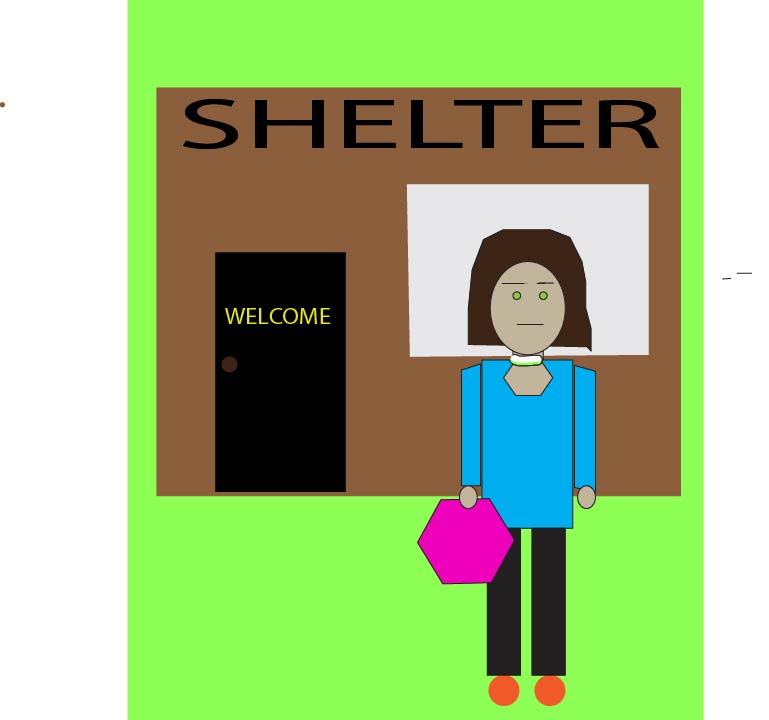
My project, Home, explores the theme of Place & Displacement by depicting a woman standing outside a shelter. The image centers on the emotional tension between belonging and uncertainty. Although the shelter is labeled “Home,” the title is deliberately ironic. The woman is positioned in front of a building that promises safety, yet her stance suggests she is still navigating instability. This tension reflects the emotional landscape of displacement: being physically near a place of refuge while still feeling psychologically unsettled.
My primary influence for this project is Yto Barrada, whose work documents border zones, migration, and the emotional weight of crossing from one place to another. In her discussion of border closures, Barrada states, “The fact that the border is closed creates this situation of longing, desire to cross, and the violence of that desire is that it's confronted by a wall.” This quote resonates deeply with the emotional state I wanted to portray. Barrada’s photograph Ceuta Border captures the moment before crossing — a moment filled with longing, hesitation, and the unknown. My project draws from the same emotional space. The woman in Home stands before a shelter on the threshold of safety, yet not fully inside it. She is between two states and embodies the psychological displacement Barrada highlights.
The shelter in my piece symbolizes temporary stability, not a permanent home. Its simple geometric structure and the welcoming sign on the door contrast with the woman’s guarded posture. This contrast mirrors Barrada’s exploration of how “home” can be both a physical location and an emotional aspiration. In my image, the woman’s resilience is communicated through her upright stance and clothing. She is not defeated. She carries strength into her situation. This aligns with Barrada’s focus on individuals who navigate displacement with dignity and agency.
For the Element of Art, I focused on shape. My project uses simple vector shapes to construct both the woman and the shelter. The woman’s body is built from clean geometric forms that emphasize clarity and stability, while the shelter uses rectangles and squares to communicate structure and groundedness. By keeping the forms minimal, I allow the emotional narrative to remain central. The contrast between the woman’s minimal, but obvious, appearance and the shelter’s rigid geometry shows the tension between human vulnerability and architectural stability. Shape is the foundation of this deliberately minimalist composition, guiding the viewer’s eye and supporting the theme. Balance is very important to me in this piece. I attempted visual balance with the elements.
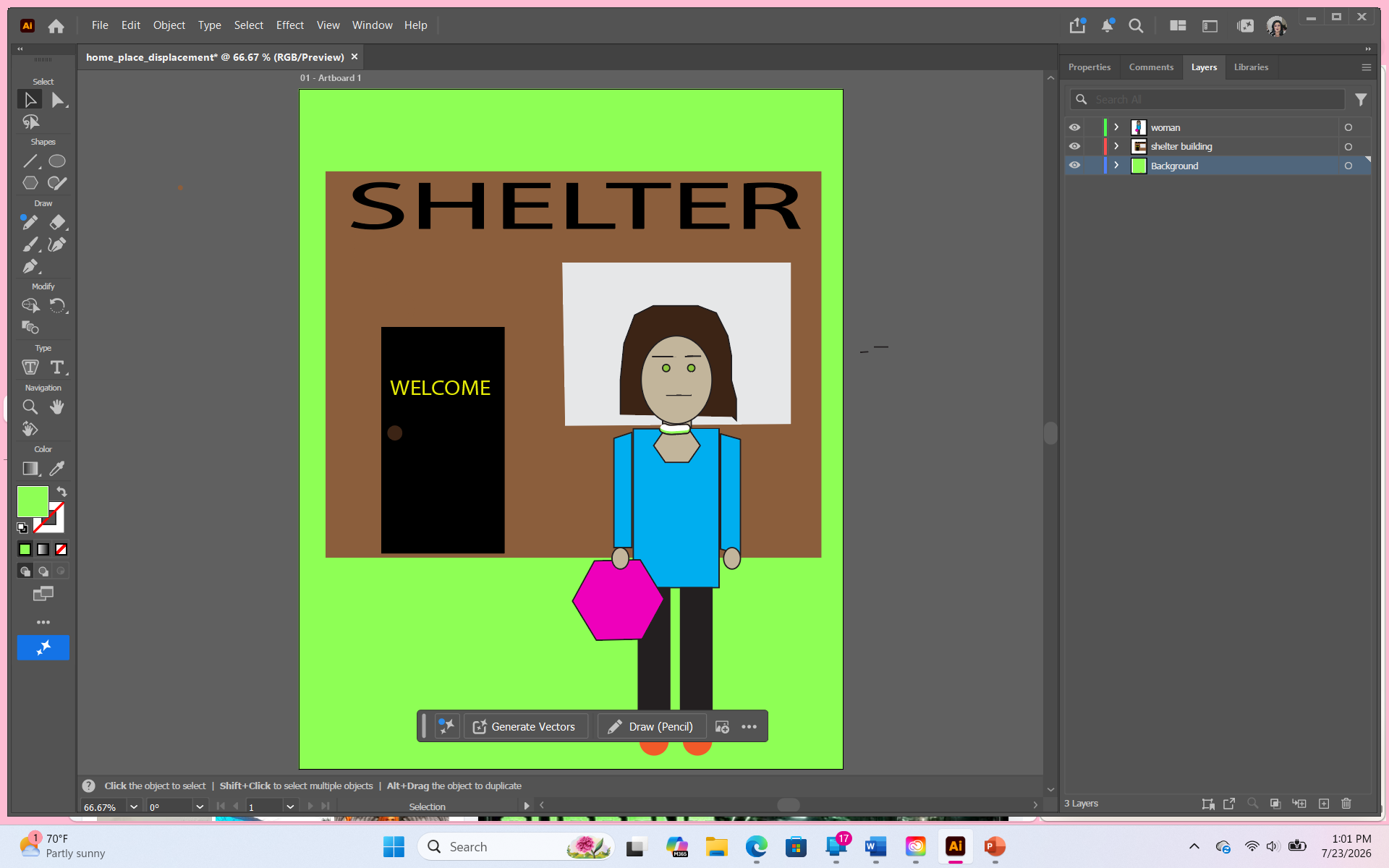
Technically, I met all project requirements by using vector shapes, grouping and sublayers to organize the figure and building, the Pen Tool for details, and RGB color space for digital clarity. The simplicity is intentional; I want the focus to be on the emotion of the situation.
In Home, I aim to show that displacement is about the stress of physical movement and it’s also about emotional states that accompany poverty and moving. Inspired by Yto Barrada, my project reflects the strength required to stand at the gate of (temporary) safety while still feeling the weight of uncertainty. Through minimalist vector forms and symbolic contrast, I explore how “home” can be present whilst also out of reach. Sometimes we are never fully inside it.
Barrada, Y. (1999). Ceuta Border, Illegally Crossing the Border into the Spanish Enclave of Ceuta, Tangier. San Francisco Museum of Modern Art. https://www.sfmoma.org/artwork/2007.101/
Barrada, Y. (n.d.). Yto Barrada — Official Website. https://ytobarrada.com/
The J. Paul Getty Museum. (n.d.). Elements of Art. https://www.getty.edu/education/teachers/building_lessons/elements_art.pdf
Gregory, R. (2026). Course materials and lectures for DTC 201: Methods for Digital Technology. Washington State University.
Mudd, P. (2026). Course materials and lectures for DTC 201: Methods for Digital Technology. Washington State University.