AliceChristineKerr.com

New Again-DTC 201 Old & New Final
AliceChristineKerr.com
New Again-DTC 201 Old & New Final
Alice Christine Kerr
July 2026
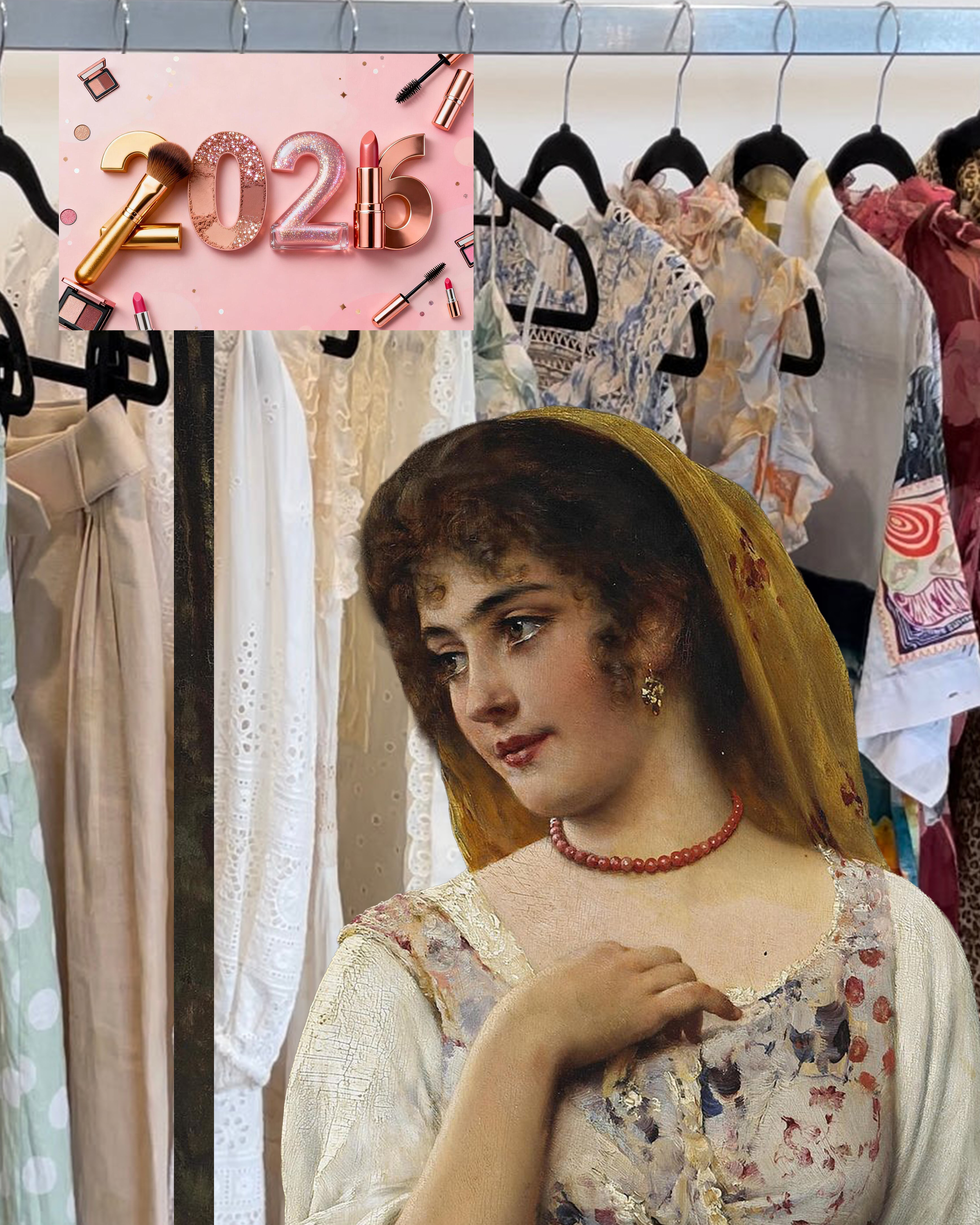
My project, New Again, is a Photoshop composite that places Eugen von Blaas's nineteenth-century portrait Zingara into a 2026 modern beauty editorial context. I chose this image because I wanted to explore how older ideals of feminine beauty always resurface in contemporary visual culture, even as trends change. Mainstays of beauty are rebranded as something original or cutting-edge. The central figure, a woman from an academic painting tradition, represents what art history values as high art: craftsmanship, permanence, and cultural prestige. I combine this high-end art with easy-to-obtain 2026 beauty items. I added elements—modern clothing displays, makeup-themed props with commercial typography. This creates a collision between historical fine art and present-day consumer visual culture.
This project connects to the theme of Old and New that we explored in this unit. Artists like Alexey Kondakov deliberately place figures from classical and neoclassical paintings into modern everyday settings, allowing viewers to see historical imagery through a contemporary lens. As Margherita Cole notes, Kondakov “plucks figures from neoclassical and romantic paintings and places” them into present-day contexts, creating an “uncanny” blending of eras (Cole). In my piece, I am doing something similar by taking an 1800s high-end painting of a beauty, Zingara, and reimagining it. My setting is not a city street but the visual language of 2026 beauty culture.
I am also influenced by Kehinde Wiley, whose work, as one gallery description states, “quote historical sources and position young black men within the field of power” (Sean Kelly Gallery). Wiley’s strategy of reusing Old Master visual traditions to talk about contemporary identity helped me think about how historical images gain new meanings when they move across time and context. As we discussed in class, the Getty’s Principles of Design describe how artists use elements like contrast, emphasis, and balance to direct viewer attention and create visual meaning (Getty). My project uses that same approach by repositioning an old-world beauty image inside a 2026 beauty framework. You will notice the similarity of the 2026 clothes hanging and the dress Zingara wears, even though they were conceived centuries apart. Viewers can question what counts as timeless versus what is treated as disposable.
The tension between high and low art is central to my image. Zingara comes from academic painting, a tradition associated with museums, elite patronage, and lasting cultural value. Fast-fashion editorial culture, by contrast, is built on speed, replication, and mass-market appeal. By combining these two forms, I want my piece to ask whether the division between high and low is as stable as it seems. The woman in the painting looks glamorous and idealized in ways that fashion marketing still tries to reproduce. The only real difference is the context: museum wall versus Instagram feed, oil paint versus digital retouching, permanence versus next season’s trend.
The main Principle of Design I used is contrast. As the Getty’s Principles of Design explain, contrast occurs when elements are noticeably different from one another, creating visual interest and emphasis (Getty). I organized the composition around differences in style, texture, and cultural meaning. The painterly quality of the original portrait contrasts sharply with the modern clothes hanging behind her as if she is shopping. I also added the gloss of a “2026” makeup-oriented signage behind the subject. The muted, historical color palette of Zingara contrasts with brighter, more saturated tones added through adjustment layers. There is also a conceptual contrast between a dress worn by an 1800s woman who owned one or two dresses and a rack of 2026 dresses behind her. At the same time, I tried to keep the image visually balanced so that neither element completely overpowers the other. The woman remains the focal point, but the modern elements frame and recontextualize her.
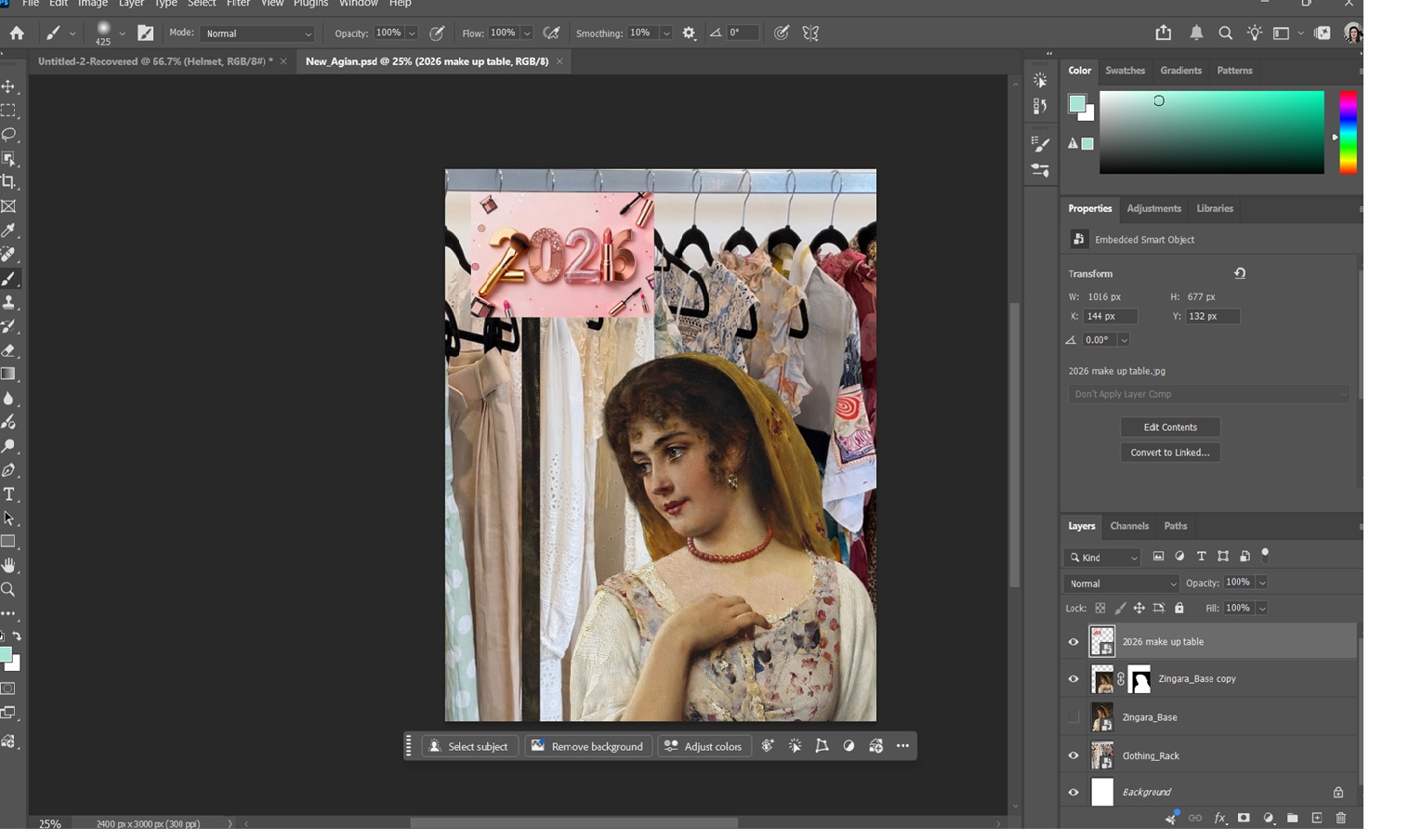
Technically, I used layers to separate the original portrait, the clothing rack image, the 2026 typography graphic, and additional design elements. I used selections and layer masking to isolate Zingara from her original background so modern elements could be placed behind and around her. I used adjustment layers to unify the color temperature and lighting across the composite, making the historical and contemporary parts feel more like a single intentional image rather than pasted-together fragments. These tools were essential for creating the recontextualization that drives the project's meaning.
Technically, this is “first piece” work. I used many techniques I learned and feel good about the result. Conceptually, it is elegant and fits with contemporary pieces. Overall, New Again is a piece that emulates and respects artists that are prevalent in the Old and New arena.
Cole, Margherita. “Classical Figures Plunge into Contemporary Life in Alexey Kondakov's Era-Blurring Paintings,” Colossal, 30 Aug. 2024, www.thisiscolossal.com/2024/02/alexey-kondakov-collages .
“Design Principles.” The Getty, www.getty.edu/education/teachers/classroom_resources/curricula/visual_arts/design_principles.html .
“Kehinde Wiley.” Sean Kelly Gallery, www.skny.com/artists/kehinde-wiley .
von Blaas, Eugen. Zingara. Late 19th century. Wikimedia Commons, commons.wikimedia.org/wiki/File:Eugen_von_Blaas_-_Zingara.jpg .